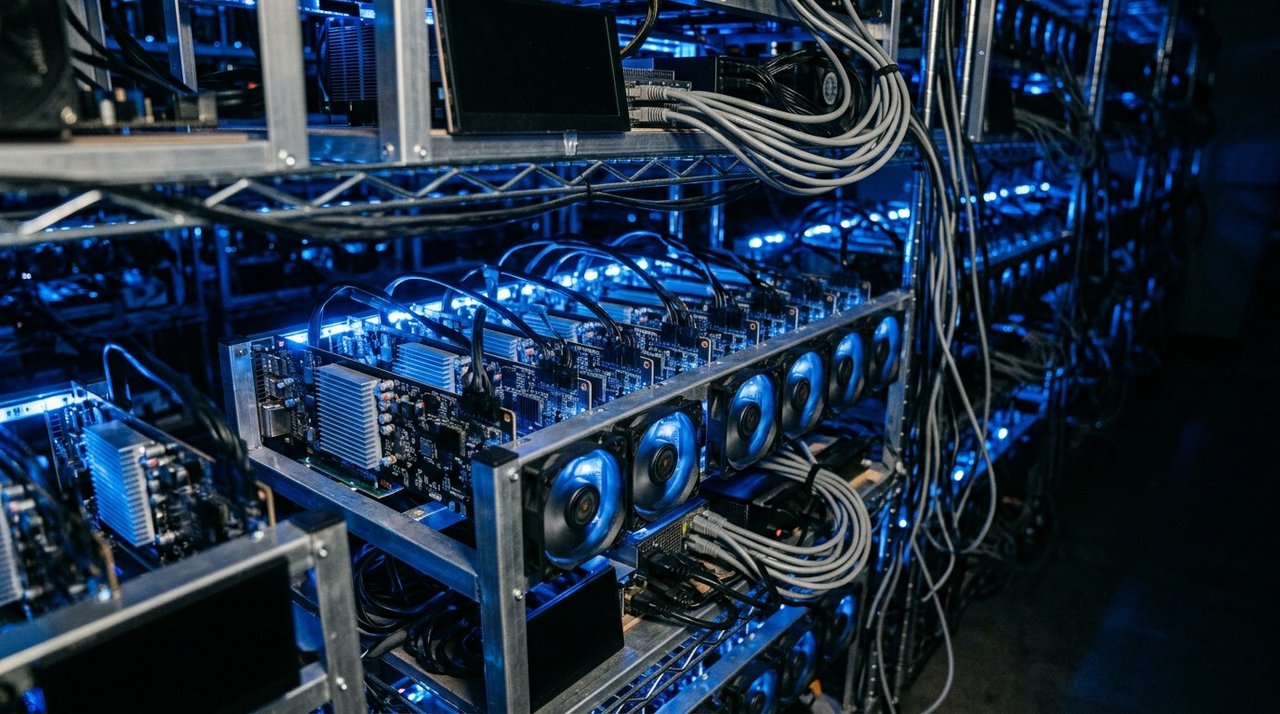
A Small Miner Hits the Jackpot
The miner collected a total of 3.129 BTC, worth $190,764, for mining block 977,057. Data from the Bitcoin explorer Mempool shows the miner used solo bitcoin-mining software from CKpool. The haul included the 3.125 BTC block subsidy, worth $190,538, plus 0.004 BTC in transaction fees, worth $226. CKpool takes a 2% fee from that total.
“Congratulations to miner bc1q~zy9j for solving the 323rd block – yet another lucky one at EU solo.ckpool.org with only ~11.1 TH of hashrate on a 3.47 TH worker,” CKpool developer Con Kolivas posted on X. “A miner of this size has about a one in 1650 chance of solving a block in a year.”
The reported 11.1 TH/s equals roughly the combined output of a few home desktop miners. That figure sits far below top machines such as Bitmain’s U3S23H Antminer, which delivers 1,160 TH/s. The gap shows just how improbable this win was for an operator of this size.
The Decade-Old Payout Problem for Small Miners
Luck decides outcomes for solo miners, but pooled miners face a different obstacle: getting paid at all. A reconstruction of 2,545 Bitcoin blocks mined by P2Pool, an early decentralized mining pool, found that none of the 15,865 payouts recorded in July 2014 fell below 0.001 BTC. A former P2Pool node operator published the findings, and Bitcoin Optech highlighted them on Nov. 20. The result exposes a constraint that developers still struggle to overcome.
Traditional mining pools typically distribute earnings through their own payment systems. P2Pool instead paid miners directly from the block reward transaction, known as the coinbase. Each recipient needs a separate transaction output, which increases the transaction’s size. Mining firmware restrictions and competition for block space also limit how many miners can receive direct payments.
To manage that limit, the original P2Pool raised the difficulty of qualifying mining shares whenever a miner’s expected payout fell below 0.001 BTC. Smaller miners therefore earned qualifying shares less often, which made their payouts less predictable. That trade-off kept the smallest participants at the margins of the system.
P2Poolv2 Proposes a Market for Mining Shares
P2Poolv2 is developing a different approach. Smaller operators could sell their mining shares instead of waiting on direct block rewards. Larger miners would keep receiving Bitcoin through coinbase transactions, while smaller participants would sell to buyers willing to aggregate their shares. Those buyers would collect the eventual rewards if their combined shares qualified for direct payouts.
The arrangement would give small miners earlier payments and shift the uncertainty of future block rewards onto buyers. Buyers would demand discounted prices for taking on that risk. The model also creates a new challenge, because smaller miners would depend on buyers offering acceptable prices before their shares expire.
The proposed market remains untested. Nobody yet knows whether enough buyers will emerge to make payouts viable for smaller operators. That open question will decide whether the design truly lowers the barrier for small miners.
BlackRock Flags the Next Halving for April 2028
Meanwhile, BlackRock’s iShares published a new explainer on the bitcoin halving. Jay Jacobs, iShares’ head of U.S. equity ETFs, wrote it with digital asset strategist Matt Kunke. They note the next halving should arrive around April 2028 and will cut the block reward to 1.5625 bitcoin from the current 3.125. Daily issuance will drop to 225 bitcoin from 450.
Halvings arrive every 210,000 blocks, or roughly every four years, and they cap total supply at 21 million bitcoin. Analysts expect the network to reach that limit around 2140. The block reward started at 50 bitcoin in 2009, and the most recent cut came on April 19, 2024, when it fell from 6.25. According to iShares, annual supply growth fell from about 4% in 2016 to 1.8% in 2020 and 0.9% in 2024, and it should reach 0.4% in 2028.
Pressure on Miners and Mixed Price Lessons
The halving slows supply growth at the expense of miners, who watch their block rewards drop by 50%. iShares noted that network hashrate typically declines in response, as older, less energy-efficient machines become unprofitable and shut down. The firm added that the hit to profitability is not as simple as the revenue drop, since mining difficulty adjusts about every two weeks. When hashrate falls, difficulty falls with it, and expected bitcoin production per unit of hashrate rises. That shift may let the most efficient operators capture a larger share as weaker miners unplug.
“Many crypto enthusiasts perceive the halving through a bullish lens as a reduced pace of bitcoin issuance could serve as a tailwind for price appreciation, assuming demand remains constant,” the authors wrote.
Past halvings took place on Nov. 28, 2012, July 9, 2016, and May 11, 2020. Bitcoin posted annual gains of 5,428% in 2013, 1,375% in 2017, and 305% in 2020. It also fell 58% in 2014, 74% in 2018, and 64% in 2022. iShares said the halving alone cannot explain those outcomes, and it pointed to market liquidity, investor adoption, and macroeconomic conditions.
What the Three Stories Say About Mining
Taken together, these stories show how uneven the economics of bitcoin mining remain. A miner with a sliver of the network’s hashrate can still win a $191,000 prize, but only with roughly one-in-1,650 annual odds. Developers, meanwhile, are still searching for ways to give small miners steady, predictable income. iShares adds that each new halving has a smaller impact on bitcoin’s inflation schedule, and that four prior halvings make a small sample from which to draw conclusions.
The coming years will test both the technical fixes and the economic assumptions behind the network. P2Poolv2’s share market needs real buyers, and miners must absorb another reward cut in 2028. For now, the lucky block 977,057 stands as a reminder that fortune can favor even the smallest operator.